Dash Integrates with Anthropic Inference Hooks to Extend Runtime Protection Across Claude Enterprise

BY Dash Team
Agent Security
6 MIN READ

Executive overview
Anthropic Inference Hooks give security policy engines a native integration point in Claude Enterprise. Depending on the configured hook events, a policy engine can evaluate prompts, tool results, and uploaded document text at the inference boundary.
Dash is extending its Claude Enterprise integration with support for Anthropic Inference Hooks. This brings Dash’s runtime threat detection and policy enforcement to additional Claude experiences, alongside the session-level protections Dash already provides for agentic workflows in Claude Code and Claude Cowork.
With the new Inference Hooks integration, organizations can apply Dash’s inline security checks across supported Claude surfaces, including Claude Web, Claude Desktop, Claude Mobile, Claude Design, and Claude Tag.
Dash integration with Claude Enterprise Inference Hooks
Dash natively integrates into Claude Enterprise Inference Hooks as your organization’s AI security server, placing Dash Runtime Protection engine in the request path.
Every inference request made to any of the Claude Enterprise end-user interfaces is caught by the inference hooks and directed to Dash Runtime Protection engine as a security checkpoint prior to sending the request to the Claude inference layer.
Dash receives the request and evaluates it in real-time against organizational security policies. Requests that comply with security policies proceed directly to the Claude inference layer. Requests violating security policies can either proceed to the Claude inference layer while Dash triggers a security alert, or be blocked immediately, preventing the content from reaching the model, depending on the enforcement action defined for each policy.
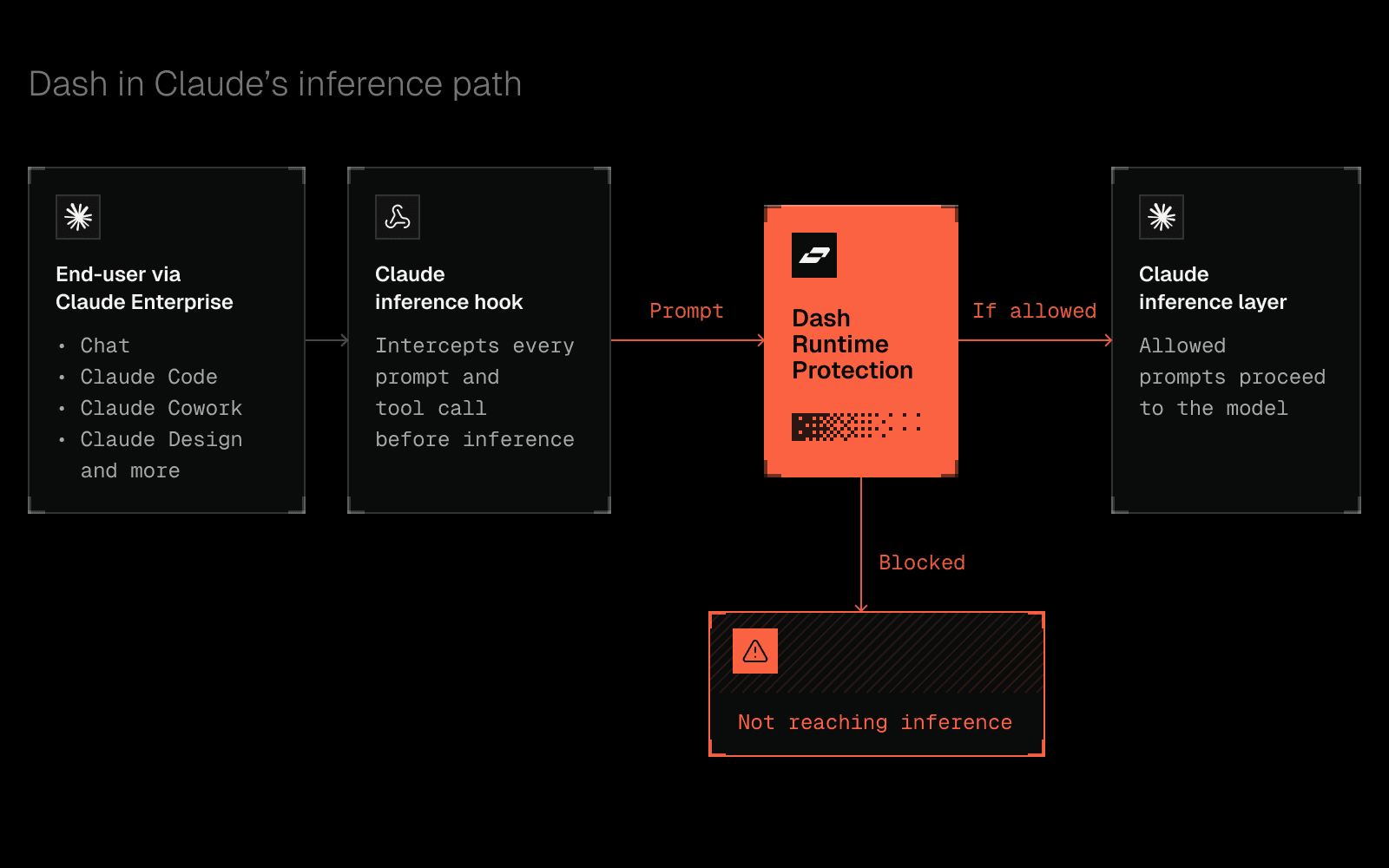
A user prompt or tool result enters Claude Enterprise, is intercepted by Claude Inference Hooks and sent to Dash Runtime Protection engine, which evaluates it against organizational security policies and returns a verdict. Allowed requests proceed to the model, while denied requests are blocked and never reach the Claude inference layer.
What teams can do with the Dash integration with Claude inference hooks
Inference Hooks let organizations act on supported Claude activity as it happens. With Dash, teams can detect and prevent a range of threats across agent workflows, based on organizational security policies, including:
Prompt injection: Malicious instructions in prompts or external content that attempt to redirect an agent or trigger unsafe actions.
Unauthorized or risky tool use: Calls to tools, APIs, MCP servers, shell commands, or integrations that violate policy.
Sensitive data exposure and credential misuse: Unsafe access to secrets or transmission of sensitive data through tools, APIs, browsers, repositories, messaging, or uploads.
Unexpected external communication: Connections to domains, services, repositories, users, or infrastructure unrelated to the task or outside approved policy.
Intent drift and rogue behavior: Agent actions that diverge from the user’s request or exceed the agent’s intended scope.
Runaway execution and resource abuse: Recursive loops, excessive token or API use, resource exhaustion, or unexpected cloud spend.
Privilege escalation and policy bypass: Attempts to gain elevated access, evade approval requirements, or circumvent enterprise controls.
Multi-step and cross-session attacks: Malicious sequences that become visible only by correlating prompts, tool calls, agent actions, and sessions.
Extending protection across Claude
Enterprises use Claude in different ways, and each creates a distinct security challenge.
Agentic developer workflows: Claude Code and Claude Cowork can work with local and remote files, invoke MCP servers, and run shell commands. Securing these workflows requires visibility into session activity and, where applicable, endpoint actions.
Everyday Claude experiences: Employees also use Claude through web, desktop, mobile, and other interfaces. Inference Hooks provide a native point for evaluating supported activity in these experiences, extending security checks beyond developer workflows.
When a configured hook event occurs, Dash evaluates the available context against active security policies and returns an allow or deny decision. Dash can combine hook events with session, tool, identity, endpoint, data and supply chain signals to help security teams understand activity and enforce policies across an agent’s workflow.
The result is a more consistent policy layer across supported Claude experiences, with enforcement based on the signals available in each environment.
Runtime security for agentic workflows
Dash evaluates agent activity across three areas:
1. Supply chain and prompt integrity
Agents may receive untrusted context from web pages, uploaded files, emails, MCP servers, and other sources. Dash detects direct and indirect prompt injection attempts and assesses agent supply chain components, including MCP servers, skills, plugins, and connectors. This helps teams identify untrusted components, excessive permissions, and shadow AI operating outside organizational oversight.
2. Runtime actions and system guardrails
Dash applies policies to agent actions using the signals available in each environment. It can help block unauthorized tool calls, APIs, or shell commands and monitor local or remote file access. With relevant endpoint coverage, organizations can also enforce controls on sensitive files, code execution, package installation, and network egress.
3. Identity, intent, and multi-step activity
A sequence of individually permitted actions can create risk when considered together. Dash correlates available identity, group, device, and session context to identify policy violations and suspicious behavior. By comparing observed activity with the user’s request and applicable policy, Dash can detect intent drift, runaway loops, and other forms of rogue agent behavior. Cross-session correlation can also help uncover activity that spans multiple agents or environments.
Granular access and egress controls
Dash provides governance controls for Claude Enterprise and agentic workflows, including:
MCP, skill, and model scoping: Define which MCP servers, skills, tools, and Claude models users or agent workflows may access.
File system governance: Apply controls to file activity in environments covered by Dash endpoint capabilities.
Egress and destination controls: Detect and block network communication to destinations outside approved policies, where network telemetry and enforcement are available.
Just-in-time access: Enable scoped, time-bound approval workflows for access to elevated tools or critical resources.
A single control plane for enterprise AI
Claude Enterprise is one part of a broader enterprise AI environment that may include coding agents, coworking agents, SaaS copilots, and cloud agent frameworks.
Dash serves as a control plane for discovering, governing, and protecting that environment. It combines Anthropic Inference Hooks with Dash’s browser and endpoint capabilities, as well as other enterprise agent platform connectors to provide centralized visibility and policy enforcement across supported AI experiences and infrastructure.
Prerequisites and getting started
To enable Inference Hook-based protection for Claude Enterprise:
Prerequisites: An active Claude Enterprise license and a Dash Security tenant.
Enable Inference Hooks: Turn on Inference Hooks in the Claude Enterprise integration settings in Dash, and configure Dash as the endpoint to which Claude Enterprise Inference Hooks routes requests.
Configure policies: Apply Dash pre-built runtime policies for data exposure, prompt injection, and MCP access, or create custom governance policies.
Executive overview
Anthropic Inference Hooks give security policy engines a native integration point in Claude Enterprise. Depending on the configured hook events, a policy engine can evaluate prompts, tool results, and uploaded document text at the inference boundary.
Dash is extending its Claude Enterprise integration with support for Anthropic Inference Hooks. This brings Dash’s runtime threat detection and policy enforcement to additional Claude experiences, alongside the session-level protections Dash already provides for agentic workflows in Claude Code and Claude Cowork.
With the new Inference Hooks integration, organizations can apply Dash’s inline security checks across supported Claude surfaces, including Claude Web, Claude Desktop, Claude Mobile, Claude Design, and Claude Tag.
Dash integration with Claude Enterprise Inference Hooks
Dash natively integrates into Claude Enterprise Inference Hooks as your organization’s AI security server, placing Dash Runtime Protection engine in the request path.
Every inference request made to any of the Claude Enterprise end-user interfaces is caught by the inference hooks and directed to Dash Runtime Protection engine as a security checkpoint prior to sending the request to the Claude inference layer.
Dash receives the request and evaluates it in real-time against organizational security policies. Requests that comply with security policies proceed directly to the Claude inference layer. Requests violating security policies can either proceed to the Claude inference layer while Dash triggers a security alert, or be blocked immediately, preventing the content from reaching the model, depending on the enforcement action defined for each policy.
A user prompt or tool result enters Claude Enterprise, is intercepted by Claude Inference Hooks and sent to Dash Runtime Protection engine, which evaluates it against organizational security policies and returns a verdict. Allowed requests proceed to the model, while denied requests are blocked and never reach the Claude inference layer.
What teams can do with the Dash integration with Claude inference hooks
Inference Hooks let organizations act on supported Claude activity as it happens. With Dash, teams can detect and prevent a range of threats across agent workflows, based on organizational security policies, including:
Prompt injection: Malicious instructions in prompts or external content that attempt to redirect an agent or trigger unsafe actions.
Unauthorized or risky tool use: Calls to tools, APIs, MCP servers, shell commands, or integrations that violate policy.
Sensitive data exposure and credential misuse: Unsafe access to secrets or transmission of sensitive data through tools, APIs, browsers, repositories, messaging, or uploads.
Unexpected external communication: Connections to domains, services, repositories, users, or infrastructure unrelated to the task or outside approved policy.
Intent drift and rogue behavior: Agent actions that diverge from the user’s request or exceed the agent’s intended scope.
Runaway execution and resource abuse: Recursive loops, excessive token or API use, resource exhaustion, or unexpected cloud spend.
Privilege escalation and policy bypass: Attempts to gain elevated access, evade approval requirements, or circumvent enterprise controls.
Multi-step and cross-session attacks: Malicious sequences that become visible only by correlating prompts, tool calls, agent actions, and sessions.
Extending protection across Claude
Enterprises use Claude in different ways, and each creates a distinct security challenge.
Agentic developer workflows: Claude Code and Claude Cowork can work with local and remote files, invoke MCP servers, and run shell commands. Securing these workflows requires visibility into session activity and, where applicable, endpoint actions.
Everyday Claude experiences: Employees also use Claude through web, desktop, mobile, and other interfaces. Inference Hooks provide a native point for evaluating supported activity in these experiences, extending security checks beyond developer workflows.
When a configured hook event occurs, Dash evaluates the available context against active security policies and returns an allow or deny decision. Dash can combine hook events with session, tool, identity, endpoint, data and supply chain signals to help security teams understand activity and enforce policies across an agent’s workflow.
The result is a more consistent policy layer across supported Claude experiences, with enforcement based on the signals available in each environment.
Runtime security for agentic workflows
Dash evaluates agent activity across three areas:
1. Supply chain and prompt integrity
Agents may receive untrusted context from web pages, uploaded files, emails, MCP servers, and other sources. Dash detects direct and indirect prompt injection attempts and assesses agent supply chain components, including MCP servers, skills, plugins, and connectors. This helps teams identify untrusted components, excessive permissions, and shadow AI operating outside organizational oversight.
2. Runtime actions and system guardrails
Dash applies policies to agent actions using the signals available in each environment. It can help block unauthorized tool calls, APIs, or shell commands and monitor local or remote file access. With relevant endpoint coverage, organizations can also enforce controls on sensitive files, code execution, package installation, and network egress.
3. Identity, intent, and multi-step activity
A sequence of individually permitted actions can create risk when considered together. Dash correlates available identity, group, device, and session context to identify policy violations and suspicious behavior. By comparing observed activity with the user’s request and applicable policy, Dash can detect intent drift, runaway loops, and other forms of rogue agent behavior. Cross-session correlation can also help uncover activity that spans multiple agents or environments.
Granular access and egress controls
Dash provides governance controls for Claude Enterprise and agentic workflows, including:
MCP, skill, and model scoping: Define which MCP servers, skills, tools, and Claude models users or agent workflows may access.
File system governance: Apply controls to file activity in environments covered by Dash endpoint capabilities.
Egress and destination controls: Detect and block network communication to destinations outside approved policies, where network telemetry and enforcement are available.
Just-in-time access: Enable scoped, time-bound approval workflows for access to elevated tools or critical resources.
A single control plane for enterprise AI
Claude Enterprise is one part of a broader enterprise AI environment that may include coding agents, coworking agents, SaaS copilots, and cloud agent frameworks.
Dash serves as a control plane for discovering, governing, and protecting that environment. It combines Anthropic Inference Hooks with Dash’s browser and endpoint capabilities, as well as other enterprise agent platform connectors to provide centralized visibility and policy enforcement across supported AI experiences and infrastructure.
Prerequisites and getting started
To enable Inference Hook-based protection for Claude Enterprise:
Prerequisites: An active Claude Enterprise license and a Dash Security tenant.
Enable Inference Hooks: Turn on Inference Hooks in the Claude Enterprise integration settings in Dash, and configure Dash as the endpoint to which Claude Enterprise Inference Hooks routes requests.
Configure policies: Apply Dash pre-built runtime policies for data exposure, prompt injection, and MCP access, or create custom governance policies.
FAQs
What are Claude Enterprise Inference Hooks?
Inference Hooks let Claude Enterprise send supported events, such as prompts or tool results, to an external policy engine for evaluation during the request flow. Dash checks the event against organizational policies and returns an enforcement decision.
How are Inference Hooks different from reviewing activity after a session?
Inference Hooks allow Dash to evaluate supported activity as it happens, before it reaches Claude’s inference layer. This can enable inline enforcement, while post-session review is primarily used for investigation and auditing.
Which Claude experiences can Dash protect through Inference Hooks?
The integration extends Dash protection to supported Claude Enterprise experiences, including Claude Web, Claude Desktop, Claude Mobile, Claude Design, and Claude Tag. Dash also provides existing hook-based protection for Claude Code and Claude Cowork, leveraging Claude client-based hooks.
Can inference hook-based protection cover Claude use on unmanaged or mobile devices?
Yes. Inference hook-based checks run through Anthropic’s infrastructure, so supported Claude experiences can be protected without installing Dash endpoint software on each device.
Can Dash block a request before it reaches the Claude Inference Layer?
Yes. When a policy is configured to deny an interaction, Dash can block it before the content reaches the model. A policy can also be configured to allow the interaction while generating an alert.
Does hook-based protection require a proxy or endpoint software?
No. Hook-based inspection does not require a network proxy or endpoint software on the user’s device. Endpoint capabilities are needed for controls over local actions such as file access or shell commands.
Which AI platforms and agent environments does Dash support beyond Claude?
Beyond Claude, Dash provides runtime protection for more than 20 coding agents and popular coworking agents such as Claude Cowork and Grok Bot. Dash also supports AI gateways, browser assistants, and custom or self-hosted agents. Coverage depends on the platform and integration.


