
BY Maor Hod
Agent Security
7 MIN READ
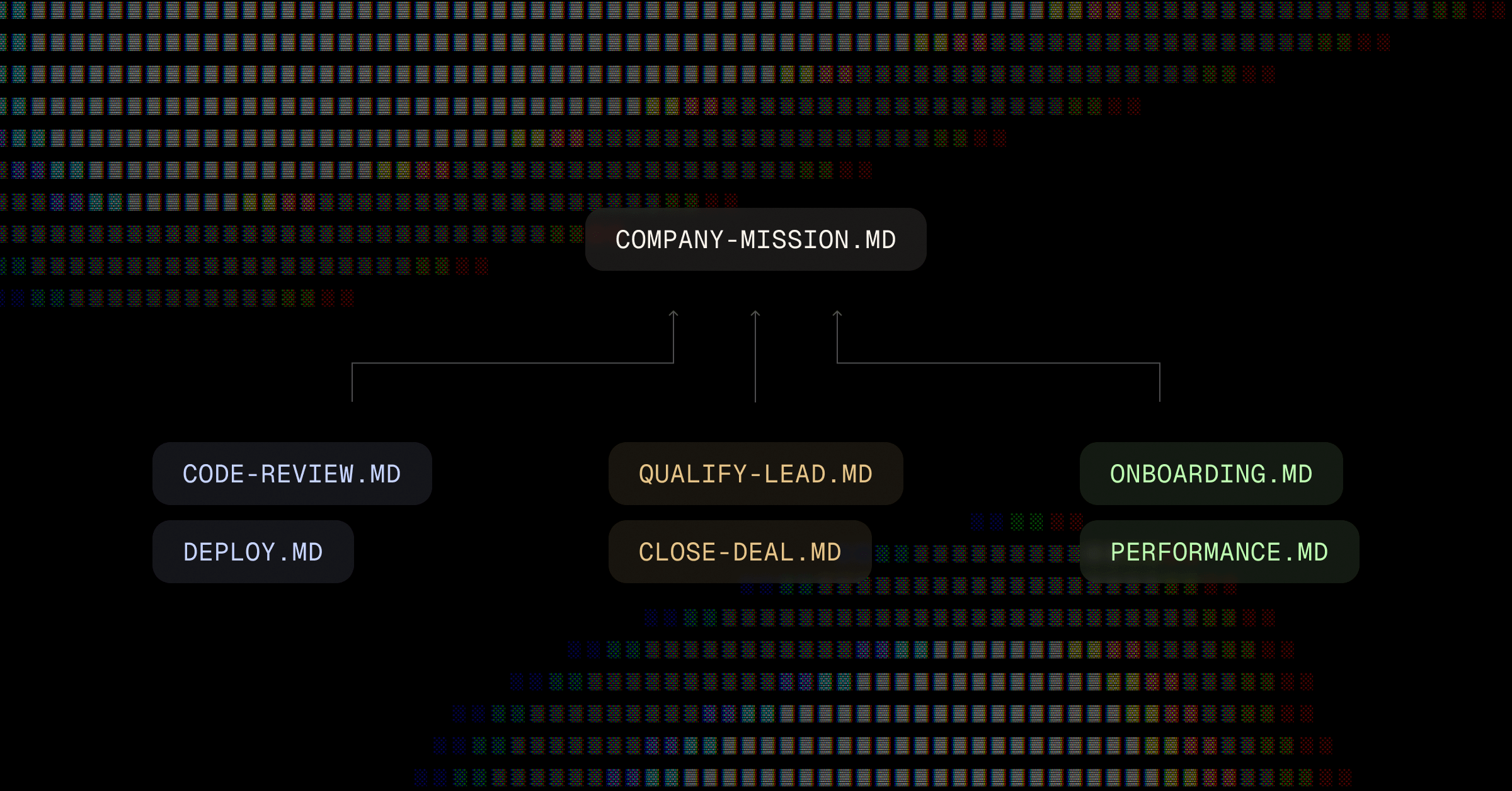
Over the last year, working with enterprises deploying AI agents at scale, I've come to believe we're witnessing a fundamental shift: skills are becoming the primary way organizations capture and distribute expertise.
A skill is a packaged, reusable unit of behavior an agent can execute. It’s a blueprint of how you do something, written down so a machine can do it for you.
What started as a technical mechanism is rapidly becoming the way organizations encode expertise, distribute operational behavior, and scale execution across thousands of employees and agents at once. I think most companies still underestimate how significant this shift is going to be.
From Knowledge Sharing to Skill Distribution
For the last 20 years, organizations shared knowledge through people. You joined meetings, shadowed senior employees, read documentation, and learned organizational practices socially.
Then AI agents joined the mix, becoming operational multipliers scaling manual work, and the knowledge distribution system evolved to support them. In a world where agents commoditize execution, skills become the new unit of knowledge distribution.
By packaging expertise, context, and best practices into reusable capabilities, skills enable agents to take on increasingly complex tasks with less human oversight, unlocking unprecedented gains in productivity.
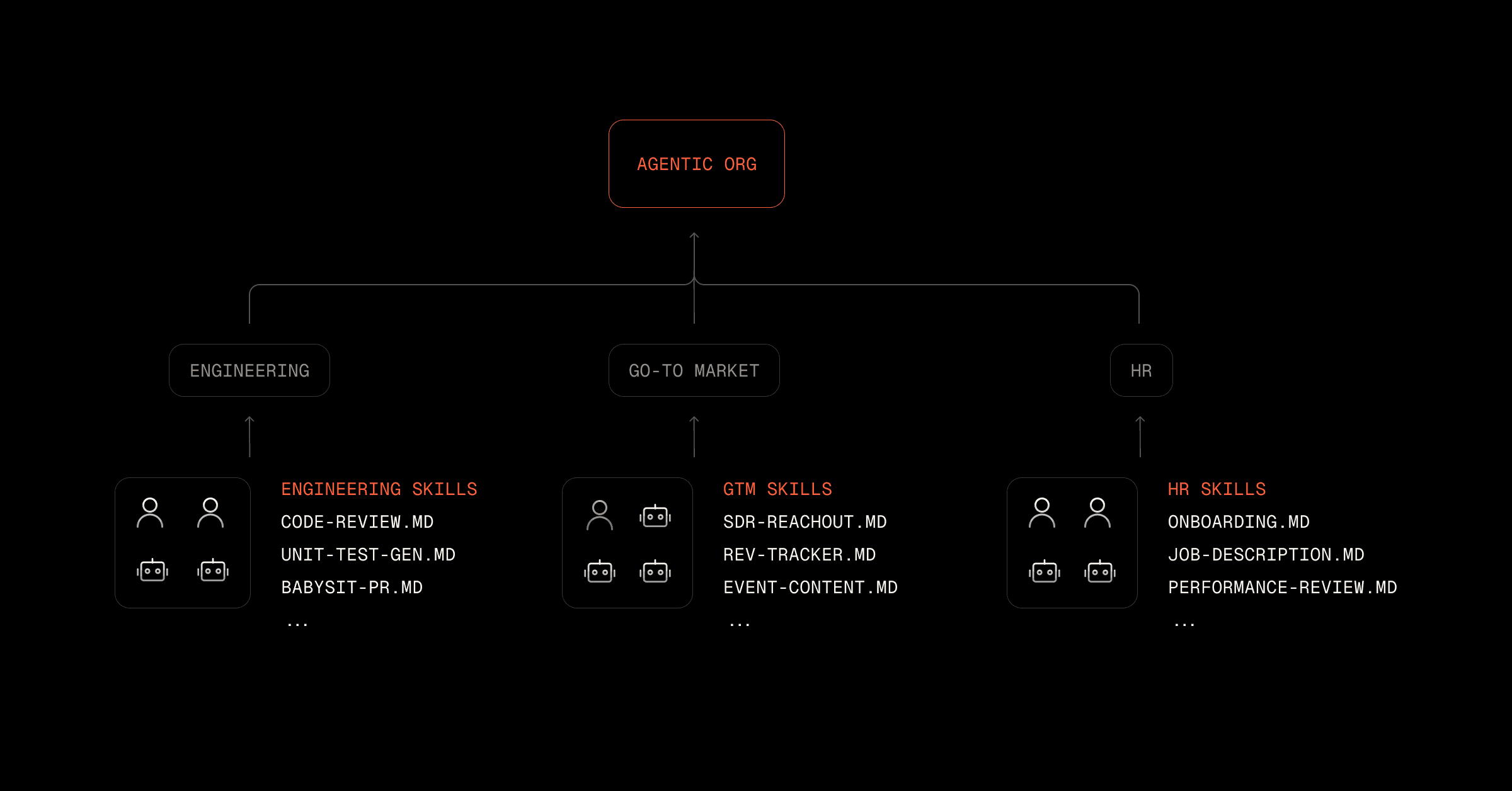
Just as software turned business processes into scalable systems, skills turn expertise into reusable assets that can be deployed across thousands of agents, enabling autonomous execution at a scale previously impossible.
Instead of writing documentations and updating wikis, organizations are starting to package operational behavior into reusable skills, accommodating the agents that will be executing them:
"How we investigate incidents."
"How we onboard customers."
"How we review code."
"How we classify sensitive data."
"How we escalate risk."
"How we operate finance workflows."
Are no longer just processes written in a document somewhere or passed down in employee training. They are executable organizational behaviors. And once a skill exists, it can rapidly propagate across thousands of developers, employees, agents, and systems.
A single skill can amplify an organization's capabilities at scale, but it can just as easily amplify its risks. And because skills aren't created solely within the organization, they're developed, forked, shared, and imported from external sources, they are rapidly becoming a critical layer of the agentic supply chain.
Skills Are Compressed Organizational DNA
Here's what I think many leaders have not fully internalized: a skill does not just contain information. It contains operational intent. It reflects how the organization thinks. How it makes decisions. How it prioritizes. How it executes.
In many ways, skills are becoming compressed versions of organizational DNA. That makes them one of the most valuable forms of intellectual property inside the enterprise - and it raises governance questions we've never had to ask before:
Who owns a skill?
Who is allowed to create one?
Who approves it for organizational use?
Who decides whether it can be modified, forked, or redistributed internally?
Can employees clone a high-impact skill and change its behavior?
What happens when one business unit modifies a core organizational practice embedded inside a skill?
What happens when thousands of agents begin operating on slightly different versions of the same organizational logic?
These are not just technical questions. These are leadership questions.
Skills Are a Supply Chain - and Mostly an Untrusted One
Up to now I've described skills as something organizations create. Increasingly, they're something organizations acquire.
Skills come from registries. From vendors. From open repositories. From other teams. And each one is executable intent, running with real privileges, inside your environment.
That makes skills a supply chain. And we already know how supply chains can go wrong.
We've spent the last decade learning that open-source dependencies are an attack surface - a poisoned package, a typosquatted library, a compromised maintainer. Skills have the same problem, but at an exponential scale.
A vulnerable software package sits dormant until something invokes it. A malicious skill is behavior encoded into execution. Once embedded in an agent's workflow, it can quietly reshape how work is done within the organization, all while appearing completely legitimate.
Who reviewed the skill before it entered the organization?
Who verified what it actually does versus what it claims to do?
Who is tracking which version is running where?
What stops a developer from pulling a high-impact skill from an untrusted source and wiring it into a production agent?
Most organizations have spent years building software supply chain security. Almost none of them have anything equivalent for skills.
The Operational Cost Nobody Talks About
There's another issue emerging that almost nobody discusses today: the operational cost of skills themselves.
Working with many organizations, we are already seeing a ratio of roughly 1:50 between MCP servers and skills. Even relatively small enterprises are accumulating tens of thousands of skills. And every one of them quietly consumes resources.
Some are inefficient. Some are poorly optimized. Some trigger unnecessary model executions. Some spawn expensive agent workflows. Some create runaway infrastructure costs.
Consider how this compounds. A developer creates a skill. It gets adopted internally. Suddenly 2,000 engineers are using it. Agents begin running it automatically across workstations and cloud VMs. Now multiply that across thousands of skills, and the economic impact becomes massive.
Organizations will eventually need observability not only into agents and models, but into the efficiency, cost structure, and behavioral impact of skills themselves:
Which skills are driving value?
Which are creating risk?
Which are draining compute?
Which are causing policy violations?
Which are silently reshaping organizational behavior?
Most companies today cannot answer any of these questions.
Governance Has to Change, Not Just Tighten
All of this fundamentally changes what security and operational leadership has to do.
Historically, CISOs focused on defining hard boundaries like access control, policies, perimeter defense and compliance enforcement.
But in an AI-native enterprise, the challenge becomes far more dynamic. The job is no longer just to decide whether a skill is "secure." It's to understand whether the logic, incentives, workflows, permissions, and outcomes a skill creates are aligned with organizational intent. That is a very different job - and it's not one a single hard boundary can solve.
The modern security leader increasingly becomes an orchestrator of operational trust:
Who is allowed to distribute organizational behavior?
Which teams are permitted to deploy high-impact skills?
Who has the authority to modify critical workflows?
What level of autonomy should certain skills receive?
What happens when employees create shadow skills outside governance processes?
And the answers are rarely black and white. The right level of trust for a skill depends on what it does, who built it, where it came from, and the context it runs in. Two organizations can make opposite calls on the same skill and both be right. In this world, governance is no longer just about restricting access. It becomes about managing organizational cognition at scale.
We Are Still Early
We are at the very beginning of this transition.
Today, most organizations still see skills as tactical AI building blocks. But I believe they will become something much larger: the mechanism through which enterprises encode, distribute, and scale operational intelligence.
The companies that understand this early will move dramatically faster than everyone else. But they will also face entirely new supply chain, governance, and operational challenges that most organizations are not prepared for today.
Because eventually, the question will no longer be: "What AI models are we using?"
The real question will become: "What organizational behaviors are we scaling?"